Thursday, 14 April 2016

L IS FOR LION : A-Z Challenge

Welcome to Day 12 of the A-Z Blogging Challenge. My theme is:


'Wildlife Encounters'


Our self-drive exploration in the Etosha National Park in Namibia was drawing to a close. (See blog post E is for Elephant.)
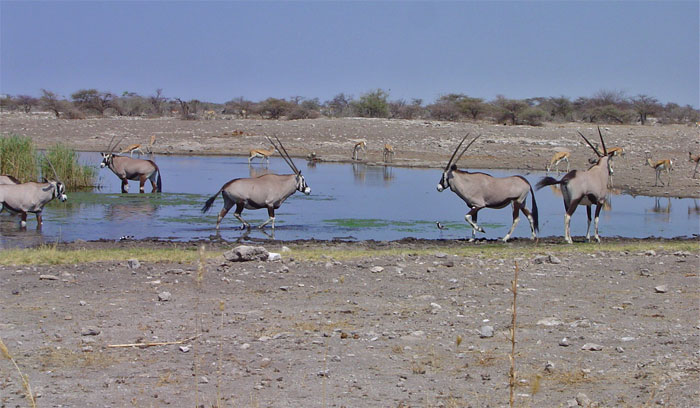
Oryx at a waterhole, Etosha
The park literature stresses the importance of remaining inside your vehicle at all times. However, after several hours driving in this vast park, it’s not always possible to - ahem - plan one’s bodily functions. Bluntly, we were both in need of a loo.  

I checked my park map to locate the nearest toilet facilities and directed my husband. When we arrived at the designated spot, there were no toilets. My husband simply opened his door and did what he had to do. This made me cross. It’s so unfairly easy for men! My husband thought it was a bit rich of me to get cross with him for being – well – a man!
Next ensued a lively discussion.

‘Just get out of the car and pee by the open door.’
‘But I'd have to drop my trousers and crouch down.’
‘And your point is?’
‘What if a lion comes along?’
‘Don’t be melodramatic. Look around you. There aren’t any lions.’


By now I was getting rather desperate and whilst still annoyed at his cavalier attitude towards my safety, I sulkily did as he suggested.
‘See? Was that really such a problem?’ he said smugly as I scrambled back into my seat.


 Not half a mile further on we were stopped in our tracks by a pair of adult mating lions.


See you tomorrow – I’m heading north east. Can you guess where and what the next animal will be?


If you want to blog-hop to the next A-Z Challenge blog, please click HERE


Wednesday, 13 April 2016

K IS FOR KOMODO DRAGON : A-Z Challenge

Welcome to Day 11 of the A-Z Blogging Challenge. My theme is:


'Wildlife Encounters'


Edited extract from one of my articles published in Air Nuigini’s in-flight magazine. (This post is longer than my usual posts, but I'm hoping its entertainment value will make you feel it worth reading.)


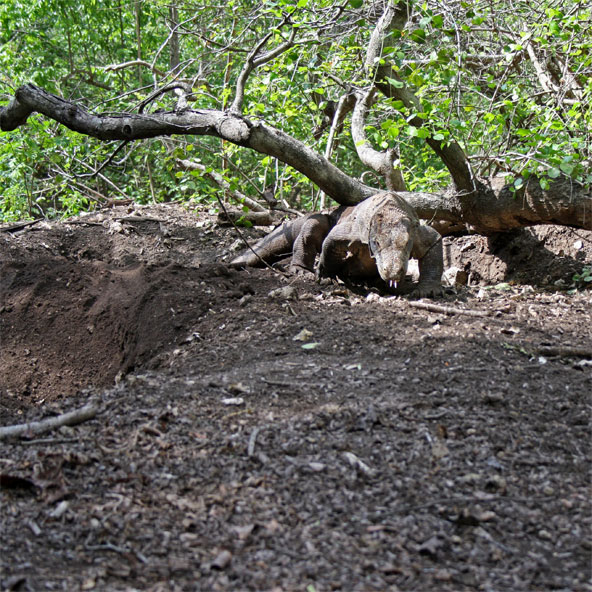
The Komodo dragon, or Komodo monitor, is the world's largest and heaviest lizard. It has a tail so powerful, one swipe can break a buffalo's leg. It is said to disembowel its victim first to feast on the toothsome entrails.


Our small boat cruised into a deep, secluded inlet on the island of Rinca in the Komodo National Park. We followed a trail through mangroves to a small settlement of houses built on stilts(!) to meet our guide. A large lizard was reclining close by, immense and quiet as a crocodile. I was alarmed and fascinated in equal measure by his hypnotic lidless stare. So much fresh meat!

Arif, carried a forked pole. He explained that the forked end was fashioned to hold the lizard's mouth shut to prevent it from biting. No one pointed out the absurdity of expecting a flimsy pole to hold back a three metre long monster, jaws closed or not. Why scare the guide?
It was time for our dragon-spotting walk. 

We soon spotted a lizard plodding along about twenty metres from us. Arif appeared unconcerned. He paused to point out large mounds of disturbed earth. They were megapode nests.


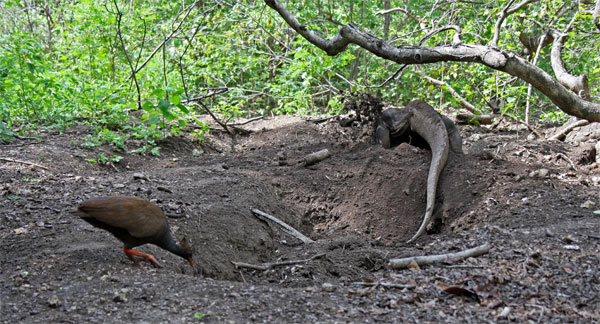
Also known as incubator birds, megapodes are about the size of a domestic chicken. Unfortunately for megapodes, Komodo dragons target their nest mounds, either to lay their own eggs in them, or to steal the birds’ eggs.
Our lizard had now reached the mounds and began to dig.
A megapode bird arrived on the scene. 


What transpired next was like watching David take on Goliath. The plucky bird scratched the ground to unearth small stones and flick them at the lizard. I couldn’t believe this puny effort would have an effect, but the lizard paused in its digging. The megapode kept up the pressure, strutting perilously close to the lizard and continuing to flick stones at it. To our astonishment the animal gave up.


Heaving itself out of the hole, the dragon now turned its attention on the little group of spectators. 

Opportunistic and intelligent it began to approach us, tongue flickering as if tasting the air to pinpoint the juiciest victim. 

I was crouched down, absorbed with taking photos: my husband yanked me to my feet and drew me backwards. 

We need not have worried. Arif stepped forwards with his forked pole and pushed the animal’s head. The lizard turned aside and plodded away.

We smiled in surprised relief: a flimsy pole had vanquished Varanus komodoensis, the largest lizard in the world.


See you tomorrow – I’m heading south west. Can you guess where and what the next animal will be?


If you want to blog-hop to the next A-Z Challenge blog, please click HERE


Tuesday, 12 April 2016

J IS FOR JABIRU : A-Z Challenge

Welcome to Day 10 of the A-Z Blogging Challenge. My theme is:


'Wildlife Encounters'

Extract from an article I wrote about Australia’s Northern Territory published in an English language newspaper in Spain:


The Mary River Wetlands abound with birdlife and crocodiles. We took a boat ride.


Slim snouted freshwater crocodiles (freshies) grow up to 3 metres long and won’t attack if undisturbed. Estuarine or saltwater crocodiles (salties) can grow up to 6 metres long. These opportunistic hunters can and will grab anything that moves. You don’t mess with salties.

Amongst a welter of fascinating birds, the huge black necked stork, or Jabiru, reigns supreme. At 130 cms tall this magnificent bird stalked like a statesman through carpets of Sacred Water Lilies while Little Corellas squawked overhead.


See you tomorrow – I’m heading north. Can you guess where and what the next animal will be?


If you want to blog-hop to the next A-Z Challenge blog, please click HERE


Monday, 11 April 2016

I IS FOR IGUANA : A-Z Challenge

Welcome to Day 9 of the A-Z Blogging Challenge. My theme is:

'Wildlife Encounters'

At first I wasn’t sure what to make of rocks littered by sneezing lizards. Sneezing lizards? Yup, they were definitely sneezing… and what sneezes! I could see stuff shooting out of their blunt snouts with no regard to the proximity of their fellows.

Now, I mentioned in my Flightless Cormorant post that the Galapagos Islands are chock-full of wonderful wildlife and that includes these Iguanas – or Marine Iguanas. And despite their rather disreputable appearance, they are nevertheless unique and wonderful creatures.


The sneezing is a result of their need to expel the salt they ingest when they’re feeding. The iguanas have developed a special nasal gland which allows them to excrete the potentially toxic salt crystals.


Only the largest iguanas are able to withstand the cold Galapagos seas long enough to actually dive underwater to feed off the seaweeds and algae. The smaller specimens simply scrape the algae off exposed rocks on the shoreline. 

Being cold blooded, all the iguanas spend a great deal of time basking on the rocks… and sneezing.


See you tomorrow – I’m heading west to a continent hitherto unvisited during this challenge. Can you guess where and what the next creature will be?


If you want to blog-hop to the next A-Z Challenge blog, please click HERE


Saturday, 9 April 2016

H IS FOR HIPPO : A-Z Challenge

Welcome to Day 8 of the A-Z Blogging Challenge. My theme is:


'Wildlife Encounters'


Here’s a fictionalised version of a real experience… (apart from the ending) that I wrote for a flash fiction competition.


ZINGING THE ZAMBEZI  IN ZAMBIA


The hippos wallowed in the shallows like a chaos of bruises.
“In the unlikely event of capsize from a hippo attack, use the boat as a shield and swim to the bank,” said Scott.
“I’m a rotten swimmer,” said Georgie.
“Just think ‘crocodiles’. Trust me, you’ll ‘zing’.”


Georgie tugged her bulky, ill-fitting lifejacket. If they capsized, she wouldn’t be ‘zinging’ anywhere. At least a crocodile might have trouble pulling her underwater in a death roll, she thought sourly.
Scott cut the engine. “Ready to catch some tigers?”


Sunbathing crocs slithered with silky swiftness into the water and hippos grunted warnings if they drifted too close.
Georgie hooked a tiger fish. It leapt out of the water in a luminescent flash of orange and pink. The line went slack.

“Lost him!”


In the excitement, they didn’t notice the boat’s position. A shockingly loud snort alerted them. A hippo was porpoising through the water at a speed that chilled Georgie’s blood. Scott dived for the ignition key.
The engine screamed and died. There was a sickening thud.
Georgie lay on the bank coughing up water. She didn’t know how she had managed to navigate the mighty Zambezi but she certainly had ‘zinged’.


See you on Monday – I’m heading west. Can you guess where and what the next animal will be?

As I mentioned yesterday, I've been away but will be back this afternoon, when I'll catch up with you.

If you want to blog-hop to the next A-Z Challenge blog, please click HERE


Friday, 8 April 2016

G IS FOR GIRAFFE : A-Z Blogging Challenge

Welcome to Day 7 of the A-Z Blogging Challenge. My theme is:


'Wildlife Encounters'


When it comes to the wackier looking animals to be found in Africa, the giraffe, with its head in the clouds, is surely right up there with the elephant and rhino.


My first sub-Saharan African adventure was in Zimbabwe and I will always remember my first wild giraffes in Hwange National Park. It’s a marvellous thing that such strangely built creatures can look both elegant and loopily lop-sided at the same time.


I saw giraffes again and again in other locations… swaying like catwalk models on the Kenyan Masai Mara, adding a picturesque addition to sunset over Namibia’s Etosha Pan - or bending awkwardly to drink in Chobe’s National Park in Botswana.


But never mind my attempts to wax lyrical over the extraordinary giraffe… I’ll let the pictures speak for themselves.


See you tomorrow - I'll be sticking around on this continent because I have a story about an animal beginning with H that I simply have to tell you. Can you guess what that animal will be?


I'm away until tomorrow afternoon and I won't be travelling with my laptop, so apologies for not commenting on your blogs today. I'll respond to all comments when I return. 

If you want to blog-hop to the next A-Z Challenge blog, please click HERE

Thursday, 7 April 2016

F IS FOR FLIGHTLESS CORMORANT : A-Z Challenge

Welcome to Day 6 of the A-Z Blogging Challenge. My theme is:


'Wildlife Encounters'

The Galapagos Islands of Ecuador are chock-full of wonderful wildlife, much of which is endemic to these beautiful islands. The Flightless Cormorant is one such creature.


It has to be said that these birds are not particularly attractive but the interesting thing about them is that they are the only cormorant in the world to have lost the ability to fly.

With their webbed feet and powerful legs, these cormorants are fantastic at catching prey underwater. It is strange that their feathers haven’t evolved to become waterproof and they are obliged to sit with their stubby little wings outstretched to dry after a hunting session.

These birds are only found on two islands in the Galapagos. Our guide asked us to keep our distance from them, for obvious reasons. 

Sadly my visit to the Galapagos was before I started travel writing and my camera wasn’t up to much. Perhaps that’s a good enough excuse to re-visit one of the most incredible places I have ever visited on this planet.


See you tomorrow - I’m going to head back east. Can you guess where and what the next animal will be?


If you want to blog-hop to the next A-Z Challenge blog, please click HERE