Wednesday, 20 April 2016

Q IS FOR QUEER UNDERWATER CREATURES : A-Z Challenge

Welcome to Day 17 of the A-Z Blogging Challenge. My theme is:


'Wildlife Encounters'

One of the prime areas to find seriously queer or weird creatures is the Lembeh Strait in North Sulawesi, Indonesia. I have had articles published about this location in Australia’s Sport Diving Magazine and in a newspaper in Spain. Here are a few random extracts from these publications in no particular order:

I was finning slow and low over the black sand.

A flash of electric blue caught my attention. I had been about to swim directly over a blue ring octopus. 

I was far too excited by the sighting to consider the implications of my near collision with one of the most dangerous animals in our oceans.

Pfeffer's flamboyant cuttlefish pulsed yellow and purple when we approached. Longhorn cowfish and helmut gurnards skimmed fast and low.


Frogfish - or anglerfish - in an unlikely range of colours remained motionless no matter how closely we approached; stoical and somehow dignified despite their absurdly comical appearance.  


Hairy Frogfish
I fell for the hairy version big-time. Of course it's not hair at all but skin filaments.  Nevertheless the hairy frogfish looks cute and cuddly enough to pet.


Lethally camouflaged dragonets, waspfish, scorpionfish and lionfish required constant vigilance as we homed in on likely spots in our search for critters. 


Snake eels hole-up in the sand with just their heads protruding. As we were photographing one a ghostly spaghetti-like tentacle emerged from the sand.  It quested blindly for a few seconds before vanishing again.  Never has the underwater world felt as alien as it did for those few eerie moments.


As a dive destination, North Sulawesi is a great place to find unusual, rare and beautiful animals (or queer underwater creatures, if you will).


See you tomorrow - I'll be heading west. Can you guess where and what the next animal will be?


If you want to blog-hop to the next A-Z Challenge blog, please click HERE


Tuesday, 19 April 2016

P IS FOR PLATYPUS : A-Z Challenge

Welcome to Day 16 of the A-Z Blogging Challenge. My theme is:


'Wildlife Encounters'


Edited extract from one of my articles published in an English language newspaper in Spain:

The platypus is an animal I had learnt about in school. Unique to Australia it is not a marsupial, but a monotreme – or egg-laying mammal. 


These little creatures live in burrows on the banks of freshwater lakes, rivers and streams. They only venture out early in the morning and evening. They are nervous as actors with stage fright.


The accommodation I picked near Mount Field National Park in Tasmania was specifically chosen because I had heard that it had a small lake containing a colony of six wild platypuses.
On the evening we arrived we caught a brief glimpse of movement out on the lake.


In the ill-lit dusk we hazily managed to identify a platypus through our binoculars. It wasn’t enough.

The following morning I rose early and crept out in the misty dawn.
As I neared the lake I spotted disturbances in the water close to the shore. I approached with care and was rewarded with three platypuses diving for breakfast, sleek as miniature otters. 


Crouched in the dew damp grass, at that moment I didn’t care if I saw nothing else in Tasmania.


See you tomorrow – I’m heading north. Can you guess where and what the next animal will be?


If you want to blog-hop to the next A-Z Challenge blog, please click HERE


Monday, 18 April 2016

O IS FOR ORANG-UTAN : A-Z Challenge

Welcome to Day 15 of the A-Z Blogging Challenge. My theme is:

'Wildlife Encounters'


Edited extract from one of my articles published in Air Nuiguini’s in-flight magazine:

The trail was slick with mud. Sweat trickled down my back. The air smelt rich and peaty from rotting leaves. Thick jungle muffled the scrapings and scratchings of unseen wildlife. My husband stopped abruptly with a small exclamation of disgust. A leech was exploring his boot.


We were in the Sepilok Forest Reserve in Sabah, Malaysia on the island of Borneo searching for pongo pygmaeus, better known as orang-utan: The Man of the Forest.
The orang-utan is the only ape in South-east Asia and their numbers are dwindling at an alarming rate.
We slogged for an hour up the track in the reserve but our search only yielded ants, millipedes and leeches. Our time was limited. If we wanted to see orang-utans we would have to visit the rehabilitation centre. 

Staff conduct two feeding sessions for the apes at a nearby platform in the forest. The orang-utans who visit this feeding station are in the last stages of rehabilitation. Whilst the animals are completely at liberty, they haven't quite severed ties with the Centre.
We followed the signs along wooden boardwalks to the busy public viewing area. 

Ropes had been placed to allow the apes easy access to the feeding platform. We watched in delight as young apes swung along these ropes, stopping periodically to take a good look at the gawping visitors.


I was struck by their silent contemplation of us and gentle behaviour with each other. ­­


We went for another walk along a trail in the reserve in the hope of seeing a male adult Man of the Forest. But the fully grown males don't need human interaction any longer and stay hidden deep in the reserve. 

All we got were leeches and millipedes, but maybe it was better that way.


See you tomorrow – I’m heading south east again. Can you guess where and what the next animal will be?


If you want to blog-hop to the next A-Z Challenge blog, please click HERE


Saturday, 16 April 2016

N IS FOR NUTHATCH : A-Z Challenge

Welcome to Day 14 of the A-Z Blogging Challenge. My theme is:


'Wildlife Encounters'


I have seen a reasonable variety of what could be described as unusual or exotic animals in the wild. However, there are plenty of animals and birds right on my doorstep that I still haven't seen. For example, I've never seen a live badger, only road kill - isn't that sad?


Last year I saw nuthatches for the first time.

They were feeding on my friend’s bird feeders in the Wye Valley in Wales.


Nuthatches breed in central and southern England and Wales. Apparently they don’t travel far from where they hatch, so this might account for them not spreading throughout the UK.


A beautiful little bird, about the size of a Great Tit and similar in behaviour to woodpeckers, the nuthatches I observed seemed willing to share the seeds and nuts with other garden birds.


Although peanuts appeared to be its food of choice.


See you on Monday – I’m heading south east for an altogether more 'exotic' animal. Can you guess where and what the next animal will be?


If you want to blog-hop to the next A-Z Challenge blog, please click HERE


Friday, 15 April 2016

M IS FOR MONKEY : A-Z Challenge

Welcome to Day 13 of the A-Z Blogging Challenge. My theme is:


'Wildlife Encounters'


There are over a dozen species of monkey in the Indian sub-continent. Out of the few I’ve seen, the common, or Hanuman, langur is the prettiest. 


Because this monkey is regarded as sacred in Hinduism, it is free to roam at will and is tolerated in villages, temples, farms and even storage facilities.


These langurs live in troops, sometimes with just one dominant male or sometimes in troops with ranked adult males. As with many other animals which live in groups like this, the dominant male spends a great deal of his time watching his back and defending his right against other males to – well – dominate.


See you tomorrow – I’m heading north west. Can you guess where and what the next animal will be?


If you want to blog-hop to the next A-Z Challenge blog, please click HERE


Thursday, 14 April 2016

L IS FOR LION : A-Z Challenge

Welcome to Day 12 of the A-Z Blogging Challenge. My theme is:


'Wildlife Encounters'


Our self-drive exploration in the Etosha National Park in Namibia was drawing to a close. (See blog post E is for Elephant.)

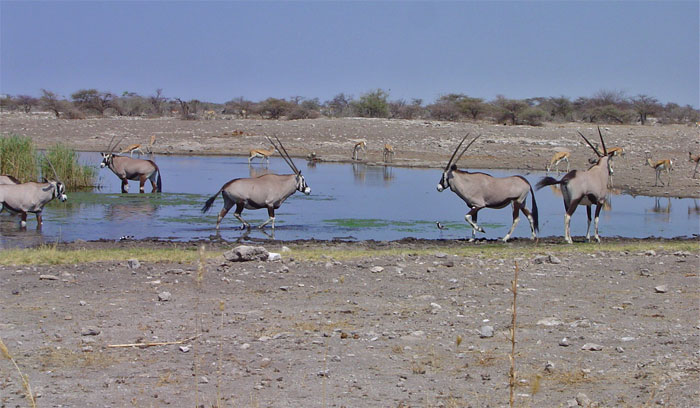
Oryx at a waterhole, Etosha
The park literature stresses the importance of remaining inside your vehicle at all times. However, after several hours driving in this vast park, it’s not always possible to - ahem - plan one’s bodily functions. Bluntly, we were both in need of a loo.  

I checked my park map to locate the nearest toilet facilities and directed my husband. When we arrived at the designated spot, there were no toilets. My husband simply opened his door and did what he had to do. This made me cross. It’s so unfairly easy for men! My husband thought it was a bit rich of me to get cross with him for being – well – a man!
Next ensued a lively discussion.

‘Just get out of the car and pee by the open door.’
‘But I'd have to drop my trousers and crouch down.’
‘And your point is?’
‘What if a lion comes along?’
‘Don’t be melodramatic. Look around you. There aren’t any lions.’


By now I was getting rather desperate and whilst still annoyed at his cavalier attitude towards my safety, I sulkily did as he suggested.
‘See? Was that really such a problem?’ he said smugly as I scrambled back into my seat.


 Not half a mile further on we were stopped in our tracks by a pair of adult mating lions.


See you tomorrow – I’m heading north east. Can you guess where and what the next animal will be?


If you want to blog-hop to the next A-Z Challenge blog, please click HERE


Wednesday, 13 April 2016

K IS FOR KOMODO DRAGON : A-Z Challenge

Welcome to Day 11 of the A-Z Blogging Challenge. My theme is:


'Wildlife Encounters'


Edited extract from one of my articles published in Air Nuigini’s in-flight magazine. (This post is longer than my usual posts, but I'm hoping its entertainment value will make you feel it worth reading.)


The Komodo dragon, or Komodo monitor, is the world's largest and heaviest lizard. It has a tail so powerful, one swipe can break a buffalo's leg. It is said to disembowel its victim first to feast on the toothsome entrails.


Our small boat cruised into a deep, secluded inlet on the island of Rinca in the Komodo National Park. We followed a trail through mangroves to a small settlement of houses built on stilts(!) to meet our guide. A large lizard was reclining close by, immense and quiet as a crocodile. I was alarmed and fascinated in equal measure by his hypnotic lidless stare. So much fresh meat!

Arif, carried a forked pole. He explained that the forked end was fashioned to hold the lizard's mouth shut to prevent it from biting. No one pointed out the absurdity of expecting a flimsy pole to hold back a three metre long monster, jaws closed or not. Why scare the guide?
It was time for our dragon-spotting walk. 

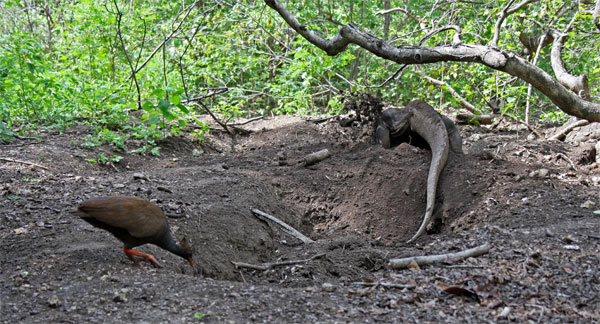
We soon spotted a lizard plodding along about twenty metres from us. Arif appeared unconcerned. He paused to point out large mounds of disturbed earth. They were megapode nests.


Also known as incubator birds, megapodes are about the size of a domestic chicken. Unfortunately for megapodes, Komodo dragons target their nest mounds, either to lay their own eggs in them, or to steal the birds’ eggs.
Our lizard had now reached the mounds and began to dig.
A megapode bird arrived on the scene. 


What transpired next was like watching David take on Goliath. The plucky bird scratched the ground to unearth small stones and flick them at the lizard. I couldn’t believe this puny effort would have an effect, but the lizard paused in its digging. The megapode kept up the pressure, strutting perilously close to the lizard and continuing to flick stones at it. To our astonishment the animal gave up.


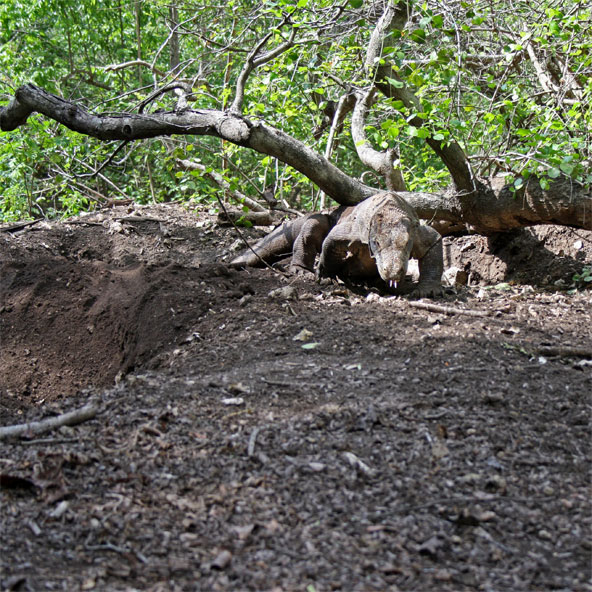
Heaving itself out of the hole, the dragon now turned its attention on the little group of spectators. 

Opportunistic and intelligent it began to approach us, tongue flickering as if tasting the air to pinpoint the juiciest victim. 

I was crouched down, absorbed with taking photos: my husband yanked me to my feet and drew me backwards. 

We need not have worried. Arif stepped forwards with his forked pole and pushed the animal’s head. The lizard turned aside and plodded away.

We smiled in surprised relief: a flimsy pole had vanquished Varanus komodoensis, the largest lizard in the world.


See you tomorrow – I’m heading south west. Can you guess where and what the next animal will be?


If you want to blog-hop to the next A-Z Challenge blog, please click HERE