Showing posts with label nature writing. Show all posts

Saturday, 1 October 2016

Insect Mini-Series - ARMOURED GROUND CRICKET

It had been an exceptionally busy night, spent in the company of a virgin.

He had gone in search of a mate the previous evening, working hard to attract female attention by rubbing his wings together – or stridulating if you want to get technical.

He rejected several plump females who responded to his calls, for the wily Armoured Ground Cricket knew that virgin crickets were slender little beauties. 

Morocco
Why a preference for a virgin? Because a first timer will mate once and lay her eggs, whereas the old pros mate and lay their eggs randomly. By sticking to the svelte virgins, he knew that a higher proportion of her offspring would be his.

When a slim young thing eventually turned up, he stridulated ardently and offered her his nuptial gift of a food sack together with his sperm pouch. She proved receptive and he carefully attached the spermatophore close to her genital opening. Job done.

However, having lost around 20% of his body weight, he needed to replenish his energy levels. It was sunrise. He staggered off in search of a meal. His appetite was eclectic, but he was partial to bird nestlings and headed across the desert scrub towards some likely looking shrubs.

In his weakened state, progress was slow, making him vulnerable. At almost 3 inches long, detection by predators was difficult to avoid. 

Gecko, Morocco
When the gecko attacked and grabbed him, the cricket mobilised his defences and autohaemorrhaged, squirting pale green, acrid smelling blood into the gecko’s face. The predator immediately dropped him and scurried off in disgust.

The cricket climbed wearily onto a black rubber car tyre, perhaps in a bid to camouflage itself.

Armoured Ground Cricket, Morocco


When the humans began to show an interest in him, he watched and waited. He didn’t have it in him to autohaemorrhage again, but if that finger moved any closer he would unleash his final defence mechanism and vomit up his last meal all over it.


I hope you enjoyed this latest offering - do leave a comment me. See you in a couple of weeks.


Friday, 16 September 2016

Insect Mini-Series: GIANT RED BULL ANT

Sometimes nest guarding was positively boring. He patrolled the area around the mound: turning this way and that, scuffing through the loose dirt and dry vegetation which disguised the nest entrance. Nothing. Nada. Not so much as a whiff of an intruder for him to ward off.


Jervis Bay, NSW, Australia
He wished he was a hunting ant instead of a guard ant. Whilst 20mm long was substantial for an ant – indeed Giant Red Bull Ants were one of the largest ant species in the world - he simply wasn’t large enough to hunt. At an impressive 25mm long, his fellow hunting ants surpassed him.

He itched for a bit of action to liven up his day.

There.

With his excellent vision, he spotted something approaching the nest. It didn’t occur to him that the intruder might be too big for him to take on.

Jervis Bay, NSW, Australia


A foraging Purple Swamphen searched the ground for snails and frogs, flicking its tail up and down as it walked. Fast and aggressive, the guard ant raced towards it. He raised his mandibles in readiness to attack with his highly developed sting. As the bird moved towards the nest he closed in.

Unfortunately the attacked swiftly became the attacker in a lighting strike that cost him a leg and mangled one of his antennae. He managed to retreat to the safety of the nest before the bird finished what he had started.


Moments later he emerged again. Injured or not, he was hard wired to guard his Queen. But the Purple Swamphen had moved on. He resumed his patrol and found that five legs worked almost as well as six.


This fiesty fella ran out onto the track I was walking on in the beautiful Jervis Bay National Park and tried to see me off. I took his photo instead.

I look forward to your comments - see you in a couple of weeks.


Friday, 2 September 2016

Insect mini-series: SMALL TORTOISESHELL BUTTERFLY

It was all a bit much. Bad enough that he had to endure all the other Small Tortoiseshells muscling in on his chosen Buddleia, but the Peacock interloper was one lepidoptera too far.


West Cork, Ireland


He watched the activity from his solitary perch with a jaundiced compound eye. The other Tortoiseshells were feeding close together, probing the flowers for nectar with their long proboscises. When the Peacock arrived they had merely budged up a bit. 

He, on the other hand, had flown off to an upper level.


It didn’t take him long to realise the advantages of his elevated position: he could observe the females and spot likely candidates to lure into his territory close to the nettle patch.

The nettles played an important role in the mating business because female Small Tortoiseshells preferred to lay their eggs on the underside of nettle leaves. The territory he had already scouted out beside the nettles was surely irresistible.

Etiquette dictated that he should wait in his territory until a female entered it before he started wooing her. However, if he spotted a potential mate, perhaps he could make an early start at the courtship procedure on the Buddleia itself. He hadn’t tried this strategy before. It was risky. Courtship entailed approaching a female from behind and drumming his antennae on her hindwings. She wouldn’t be expecting it while she was feeding and might react as if she’d been goosed. Still… he who dares…


A fetching looking female alighted to feed on a flower below him. He landed beside her. Now he just had to summon his courage.


Do let me know if you're enjoying my insect series. See you in a couple of weeks.

Saturday, 20 August 2016

Insect Mini-Series - HUNTSMAN SPIDER

Nocturnal hunting came with its own set of rules, rewards and hazards. While she risked the dangers of the hunter becoming the hunted, she enjoyed a freedom of movement that only a webless spider could experience. 

Huntsman, Fiji

Fruit Bat, Fiji
On this particular night she had stalked a beetle up into the canopy of a papaya tree and found herself confronted by a flying fox – or fruit bat. The bat had taken umbrage at the interloper who had disturbed it at its evening meal, causing the Huntsman to make a rapid retreat.


The spider leapt, jumped and skittered down the papaya tree and took refuge on a nearby house where she had spotted some interesting activity. Moths were hurling themselves against a window in a vain attempt to reach the light within. 

Gecko,  Morocco
She had barely positioned herself to pounce on a juicy looking specimen when she spotted a gecko approaching, no doubt with the same idea.


Now the Huntsman had a serious problem. With a potential leg span of 160mm she was the largest spider in this part of the world, but geckos were dangerous predators. She knew the lizard would have no qualms about taking her on. Indeed, a spider of her dimensions was probably a far more attractive proposition to the gecko than a slim moth with insubstantial wings.

The Huntsman withdrew.

She needed to find a hiding place because she knew that more geckos would arrive to feast on the moths. Her preferred choice was loose tree bark to slide and hide beneath, but with sunrise imminent she didn't have time to leave the security of the building to go in search of something more suitable. 


She therefore elected to remain under the eaves of the house.


Now, if only the creature that lived within the house would stop flashing a light in her eyes, she might have been content to stay a while. As it was, she waited patiently for night to descend once more so that she could make good her escape.


Sunday, 7 August 2016

Insect Mini-Series - LARGE RED DAMSELFLY


The most enjoyable part of his job was done. All he had to do now was hang onto her head.


Large Red Damselfly, West Cork, ROI

It was a bit boring, but if he let her go another damselfly might catch her and turf out his sperm. So he waited.

From his leafy vantage he surveyed his realm with satisfaction.

When he had reached maturity he had searched for a good breeding ground. The vegetation beside this slow running stream offered an excellent habitat.


Yet it was hard work. There always seemed to be another male wanting his piece of prime real estate and he was constantly defending his territory. His reward for his vigilance was this female who had flown in to check him out and found him worthy.

From the moment she arrived and indicated her willingness, he grabbed her by her thorax before moving into the tandem pose while he readied his sperm. It didn’t take him long. Within a few seconds he changed position and they curled themselves into a wheel to mate. Copulation took a good deal longer - about fifteen minutes – although he didn’t mind that!


When they finished she tried to fly away but he grabbed her head and held her in the tandem position again. It was only by forcing her to stay attached to him, that he could guarantee she wouldn’t mate with rival males before she laid her eggs.

He looked down into the stream at the submerged leaves and stems; the perfect place to lay her eggs was right below them.

He wished she would get on with it.


Sunday, 31 July 2016

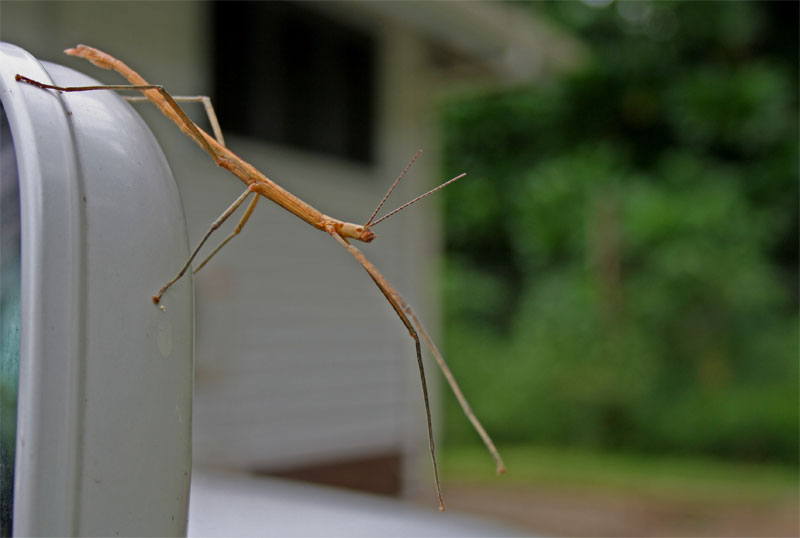
Insect Mini-Series - STICK INSECT

You might ask what he was doing climbing a car. 
Like all adventurous mountaineers before him, he might answer, ‘Because it was there.’

Stick Insect, Fiji


After all, with compound eyes which allowed him to see well during his largely nocturnal activities, he couldn’t use the excuse that he had mistaken the car for a tree... or could he?

Because, while out foraging, this dedicated herbivore had indeed climbed up a car and was now perched somewhat precariously on the wing mirror. Only he knew why he came to be there, a stick insect enigma, surveying his world from his unusual vantage point.  

Aware of his vulnerability, he rocked gently, mimicking a twig moving in the breeze. 

In the normal course of events this behaviour might fool predators, but stuck out on the wing mirror in broad daylight meant he was stretching his luck. 

Unfortunately, he wasn’t the sort of stick insect who could, chameleon-like, change colour to blend in with his surroundings.

If a predator did approach, he could drop to the ground and play dead, thus fooling the enemy into thinking he was nothing more than an indigestible twig. And if that didn’t work, he could unleash his pièce de résistance and vomit up the contents of his stomach. That should do the trick.


Do let me know if you're enjoying this insect mini-series.

See you next week.


Sunday, 17 July 2016

Insect Mini-Series : CARPENTER BEE

I'm preparing for the Cork Literary Festival which kicks off this weekend and I'm short of time, so here's a post from last year which most of you won't have seen.


Carpenter Bee, Morocco
It was his nature to be solitary. 

He flitted from flower to flower. Always searching, always feeding, always alone. No hive for the likes of him.

Something.

He paused between the flowers, testing the air for intruders.

Uncertain, he hovered, turning first one way, then the other. A vibration ruffled his iridescent navy blue wings. It was barely perceptible, yet it sparked a need, a longing, an imperative.

He turned a full circle, perplexed. The vibration receded.

A scent distracted his attention. He descended to land on the thistle’s purple flower head. He crawled into position and probed until his proboscis found the channel leading to the nectar.

Now the vibration interrupted his feeding again, so subtle he almost missed it. The imperative strengthened.

What?

He lifted away from the thistle and turned to face the disturbance. A distant shape was coming towards him. The imperative overcame his instinct to flee. Instead he flew directly towards the shape, his body humming and pulsing in bewilderment and excitement.

The shape coalesced into another Carpenter bee and when he reached her his confusion dissolved.

Their tiny bodies briefly joined in fleeting harmony, the imperative to mate overcoming their shy dispositions.

She immediately began to search for suitable wood in which to drill and lay her eggs. He dutifully followed. Soon he would have a nest to guard.


******************************


Do let me know if you've enjoyed this and whether you'd like to read more from my Insect Mini-Series. See you next week.


Tuesday, 6 October 2015

ARMOURED GROUND CRICKET - Insect Mini-Series

Story number 7 in my insect mini-series


Morocco
It had been an exceptionally busy night, spent in the company of a virgin.
He had gone in search of a mate yesterday evening, working hard to attract female attention by rubbing his wings together – or stridulating if you want to get technical.
He rejected several plump females who responded to his calls, for the wily Armoured Ground Cricket knew that virgin crickets were slender little beauties.

Why a preference for a virgin? Because a first timer will mate once and lay her eggs, whereas the old pros mate and lay their eggs randomly. By sticking to the svelte virgins, he knew that a higher proportion of the offspring would be his.

Ouzoud, Morocco
When a slim young thing eventually turned up last night, he stridulated ardently and offered her his nuptial gift of a food sack together with his sperm pouch. She proved receptive and he carefully attached the spermatophore close to her genital opening. 
Job done.
However, having lost around 20% of his body weight, he needed to replenish his energy levels. It was sunrise. 
He staggered off in search of a meal. His appetite was eclectic, but he was partial to bird nestlings and headed across the desert scrub towards some likely looking shrubs.

In his weakened state, progress was slow, making him vulnerable. At almost 3 inches long, detection by predators was difficult to avoid.

When the lizard attacked and grabbed him, the cricket mobilised his defences and autohaemorrhaged, squirting pale green, acrid smelling blood into the lizard’s face. The predator immediately dropped him and scurried off in disgust.

Armoured Ground Cricket, Morocco

 The cricket climbed wearily onto a black rubber car tyre, perhaps in a bid to camouflage itself.
When the humans started to show an interest in him, he watched and waited. He didn’t have it in him to autohaemorrage again, but if that finger moved any closer he would unleash his final defence mechanism and vomit up his last meal all over it.


Thursday, 10 September 2015

GIANT RED BULL ANT - Insect Mini-Series

Here is story number 6 in my insect mini-series


Giant Red Bull Ant - Jervis Bay, Australia

Sometimes nest guarding was positively boring. He patrolled the area around the mound: turning this way and that, scuffing through the loose dirt and dry vegetation which disguised the nest entrance. Nothing. Nada. Not so much as a whiff of an intruder for him to ward off.

He wished he was a hunting ant instead of a guard ant. Whilst 20mm long was substantial for an ant – indeed Giant Red Bull Ants were one of the largest ant species in the world - he simply wasn’t large enough to hunt. At an impressive 25mm long, his fellow hunting ants surpassed him.

He itched for a bit of action to liven up his day.

There.

With his excellent vision, he spotted something approaching the nest. It didn’t occur to him that the intruder might be too big for him to take on.


Purple Swamphen

A foraging Purple Swamphen searched the ground for snails and frogs, flicking its tail up and down as it walked. Fast and aggressive, the guard ant raced towards it. He raised his mandibles in readiness to attack with his highly developed sting. As the bird moved towards the nest he closed in.

 Unfortunately the attacked swiftly became the attacker in a lighting strike that cost the ant a leg and mangled one of his antennae. He managed to retreat to the safety of the nest before the bird finished what he had started.


Moments later the Giant Red Bull guard ant emerged again. Injured or not, he was hard wired to guard his Queen. But the Purple Swamphen had moved on. He resumed his patrol and found that five legs worked almost as well as six.


Tuesday, 18 August 2015

Small Tortoiseshell Butterfly - Insect mini-series

Here is story number 5 in my insect mini-series

Small Tortoiseshells and Peacock Butterfly (West Cork, ROI)
It was all a bit much. Bad enough that he had to endure all the other Small Tortoiseshells muscling in on his chosen Buddleia, but the Peacock interloper was one lepidoptera too far.

He watched the activity from his solitary perch with a jaundiced compound eye. The other Tortoiseshells were feeding close together, probing the flowers for nectar with their long proboscises. When the Peacock arrived they had merely budged up a bit. He, on the other hand, had flown off to an upper level.


It didn’t take him long to realise the advantages of his elevated position: he could observe the females and spot likely candidates to lure into his territory close to the nettle patch.
The nettles played an important role in the mating business because female Small Tortoiseshells preferred to lay their eggs on the underside of nettle leaves. The territory he had already scouted out beside the nettles was surely irresistible.
Etiquette dictated that he should wait in his territory until a female entered it before he started wooing her. However, if he spotted a potential mate, perhaps he could make an early start at the courtship procedure on the Buddleia itself. He hadn’t tried this strategy before. It was risky. Courtship entailed approaching a female from behind and drumming his antennae on her hindwings. She wouldn’t be expecting it while she was feeding and might react as if she’d been goosed. Still… he who dares…


A fetching looking female alighted to feed on a flower below him. He landed beside her. Now he just had to summon his courage.


Wednesday, 12 August 2015

Huntsman Spider - Mini-series of insect stories

Here is story number 4 in my insect mini-series


Huntsman Spider - Savusavu, Fiji


Nocturnal hunting came with its own set of rules, rewards and hazards. While she risked the dangers of the hunter becoming the hunted, she enjoyed a freedom of movement that only a webless spider could experience.

Fruit Bat - or Flying Fox in Papaya Tree, Fiji
On this particular night she had stalked a beetle up into the canopy of a papaya tree, and found herself confronted by a flying fox – or fruit bat. The bat had taken umbrage at the interloper who had disturbed it at its evening meal, causing the Huntsman to make a rapid retreat. The spider leapt, jumped and skittered down the papaya tree and took refuge on a nearby house where she had spotted some interesting activity. Moths were hurling themselves against a window in a vain attempt to reach the light within.


 She had barely positioned herself to pounce on a juicy looking specimen when she spotted a gecko approaching, no doubt with the same idea.
Now the Huntsman had a serious problem. With a potential leg span of 160mm she was the largest spider in this part of the world, but geckoes were dangerous predators. She knew the lizard would have no qualms about taking her on. Indeed, a spider of her dimensions was probably a far more attractive proposition to the gecko than a slim moth with insubstantial wings.
The Huntsman withdrew.

She needed to find a hiding place because she knew that more geckoes would arrive to feast on the moths. Her preferred choice was loose tree bark to slide and hide beneath, but with sunrise imminent she didn’t have time to leave the security of the building to go in search of something more suitable. She therefore elected to remain under the eaves of the house.
Now, if only the creature that lived within the house would stop flashing a light in her eight eyes, she might have been content to stay a while. As it was, she waited patiently for night to descend once more so that she could make good her escape.


Wednesday, 24 June 2015

Large Red Damselfly - Mini-series of insect stories


Here is story number 3 in my insect mini-series


Large Red Damselflies (West Cork, ROI)


The most enjoyable part of his job was done. All he had to do now was hang onto her head.

It was a bit boring, but if he let her go another damselfly might catch her and turf out his sperm. So he waited.


From his leafy vantage he surveyed his realm with satisfaction.

When he had reached maturity he had searched for a good breeding ground. The vegetation beside this slow running stream offered an excellent habitat.

Yet it was hard work. There always seemed to be another male wanting his piece of prime real estate and he was constantly defending his territory. His reward for his vigilance was this female who had flown in to check him out and found him worthy.

From the moment she arrived and indicated her willingness, he grabbed her by her thorax before moving into the tandem pose while he readied his sperm. It didn’t take him long. Within a few seconds he changed position and they curled themselves into a wheel to mate. Copulation took a good deal longer - about fifteen minutes – although he didn’t mind that! 


When they finished she tried to fly away but he grabbed her head and held her in the tandem position again. It was only by forcing her to stay attached to him, that he could guarantee she wouldn’t mate with rival males before she laid her eggs. 


He looked down into the stream at the submerged leaves and stems; the perfect place to lay her eggs was right below them.

He wished she would get on with it.


Thursday, 18 June 2015

Stick Insect - Mini-series of insect stories

Here is the second story in my insect mini-series


Stick Insect (Savusavu, Fiji)


You might ask what he was doing climbing a car.
Like all adventurous mountaineers before him, he might answer, ‘Because it was there.’
After all, with compound eyes which allowed him to see well during his largely nocturnal activities, he couldn’t use the excuse that he had mistaken the car for a tree... or could he?
Because, while out foraging, this dedicated herbivore had indeed climbed up a car and was now perched somewhat precariously on the wing mirror. Only he knew why he came to be there, a stick insect enigma, surveying his world from his unusual vantage point. 
Aware of his vulnerability, he rocked gently, mimicking a twig moving in the breeze. In the normal course of events this behaviour might fool predators, but stuck out on the wing mirror in broad daylight meant he was stretching his luck. Unfortunately, he wasn’t the sort of stick insect who could, chameleon-like, change colour to blend in with his surroundings. 
If a predator did approach, he could drop to the ground and play dead, thus fooling the enemy into thinking he was nothing more than an indigestible twig. And if that didn’t work, he could unleash his pièce de résistance and vomit up the contents of his stomach. That should do the trick.


Saturday, 13 June 2015

Carpenter Bee - Mini-series of insect stories

As a result of my promise under the Photographing Hidden Gems post on 3 June, here is the first of a mini-series of stories based on some of my insect photographs


CARPENTER BEE  (Ouzoud, Morocco)
 It was his nature to be solitary. He flitted from flower to flower, searching, feeding. Always searching, always feeding, always alone. No hive for the likes of him.
Something.
He paused between the flowers, testing the air for intruders.
Uncertain, he hovered, turning first one way, then the other. A vibration ruffled his iridescent navy blue wings. It was barely perceptible, yet it sparked a need, a longing, an imperative.
He turned a full circle, perplexed. The vibration receded.
A scent distracted his attention. He descended to land on the thistle’s purple flower head. He crawled into position and probed until his proboscis found the channel leading to the nectar.
Now the vibration interrupted his feeding again, so subtle he almost missed it. The imperative strengthened.
What?
He lifted away from the thistle and turned to face the disturbance. A distant shape was coming towards him. The imperative overcame his instinct to flee. Instead he flew directly towards the shape, his body humming and pulsing in bewilderment and excitement.
The shape coalesced into another Carpenter bee and when he reached her his confusion dissolved.
Their tiny bodies briefly joined in fleeting harmony, the imperative to mate overcoming their shy dispositions.
She immediately began to search for suitable wood in which to drill and lay her eggs. He dutifully followed. Soon he would have a nest to guard.


This little chap received a passing mention in my travel essay ‘African for Softies’ published in the Writers Abroad anthology: Foreign and Far Away